
Close Menu
    Facebook X (Twitter) Instagram
    SciTechDaily
    • Biology
    • Chemistry
    • Earth
    • Health
    • Physics
    • Science
    • Space
    • Technology
    Facebook X (Twitter) Pinterest YouTube RSS
    SciTechDaily
    Home»Biology»Scientists Discover New Property of Immune Cells – “Like Guided Missiles”
    Biology

    Scientists Discover New Property of Immune Cells – “Like Guided Missiles”

    By University of Texas Health Science Center at San AntonioApril 17, 2023No Comments3 Mins Read
    Facebook Twitter Pinterest Telegram LinkedIn WhatsApp Email Reddit
    Share
    Facebook Twitter LinkedIn Pinterest Telegram Email Reddit
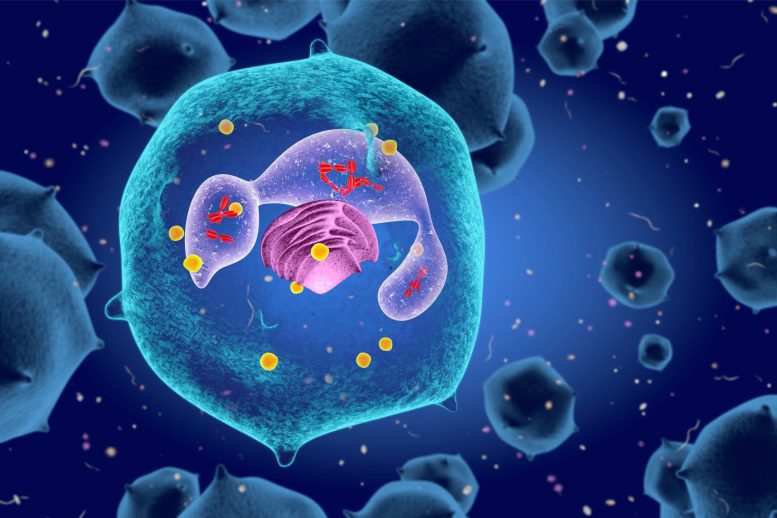
    Immune Cells Anatomy
    Researchers from UT Health San Antonio discovered that certain immune cells, called invariant killer T (iNKT) cells, possess a unique homing property that directs them to the skin at birth, providing crucial protection and lifelong immunity. These skin-homing iNKT cells also promote hair follicle development and cooperate with commensal bacteria to maintain skin health and prevent pathogenic bacterial overgrowth.

    Infants Are Given Protection Against Bacteria That Cause Diseases

    Researchers from The University of Texas Health Science Center at San Antonio (UT Health San Antonio) have uncovered that certain immune cells possess a homing property that guides them to the skin of the newborn to provide protection.

    “These T cells home in on the skin like a guided missile,” said Na Xiong, Ph.D., professor of microbiology, immunology, and molecular genetics in the health science center’s Joe R. and Teresa Lozano Long School of Medicine. “They have a different homing property than other T cells. We identified the mechanism through which this homing activity occurs.”

    Localization of these T cells to the skin is important not only at birth but for lifelong immunity, said Xiong, senior author of an article that appeared on the cover of the February 2023 issue of Nature Immunology.

    In the womb, a mother’s defenses protect a fetus against bacteria. At birth, the skin and other tissues such as the gut are exposed to commensal bacteria. These are harmless bacteria that are beneficial by keeping any disease-causing bacteria in check.

    Programming and Function of iNKT Cells

    The skin-homing cells are called invariant killer T (iNKT) cells. These immune cells emanate from and are programmed in an organ called the thymus. In humans, this organ is located between the lungs.

    The iNKT cells cooperate with the commensal bacteria to preserve skin health and act as a barrier for the body against bacterial pathogens, Xiong said.

    “We found that if the iNKT cells do not properly go to the skin, or if there is no such population in the skin, there will be dysregulation of commensal bacteria in the skin and the bacterial composition will be changed,” Xiong said. “This can result in not enough friendly bacteria being present, enabling potentially pathogenic bacteria to overgrow.”

    In a second important finding, the researchers observed that the skin-homing iNKT cells help promote hair follicle development. The cells situate preferentially around follicles and are not the only ones present there, Xiong said. “Within the hair follicle, there are also a lot of commensal bacteria. It is one place they like to stay,” he said.

    The follicles themselves are critical sites of immune defense, he added.

    Reference: “Developmentally programmed early-age skin localization of iNKT cells supports local tissue development and homeostasis” by Wei-Bei Wang, Yang-Ding Lin, Luming Zhao, Chang Liao, Yang Zhang, Micha Davila, Jasmine Sun, Yidong Chen and Na Xiong, 9 January 2023, Nature Immunology.
    DOI: 10.1038/s41590-022-01399-5

    Collaborators are from Pennsylvania State University.

    The study was funded by the National Institute of Allergy and Infectious Diseases and the National Institute of Arthritis, Musculoskeletal, and Skin Diseases of the National Institutes of Health.

    Never miss a breakthrough: Join the SciTechDaily newsletter.
    Follow us on Google and Google News.

    Immune Cells Microbiology Popular University of Texas at San Antonio
    Share. Facebook Twitter Pinterest LinkedIn Email Reddit

    Related Articles

    New Research Shows Human Intestinal Bacteria Can Trigger Multiple Sclerosis

    Scientists Discover Mussels and Sponges Thrive on Oil with the Help of Symbiont Bacteria

    Modified RNA Extends Telomeres in Human Cells, Turns Back Aging Clock

    Researchers Convert Human Stem Cells to Functional Lung Cells

    Chemical Model Shows How First Life Forms Might Have Packaged RNA

    Superoxide Reacts With Manganese to Aid in Environmental Cleanup

    Oxygen Depletion and Acidification Accelerate Coral Death

    Marine Worm Thrives on Steady Diet of Deadly Poisons

    MSU Researchers Show How New Viruses Evolve Through Mutations

    Leave A Reply Cancel Reply

    • Facebook
    • Twitter
    • Pinterest
    • YouTube

    Don't Miss a Discovery

    Subscribe for the Latest in Science & Tech!

    Trending News

    This Copper Drug Clears Alzheimer’s Brain Toxins and Boosts Memory

    Adults Over 65 Lost Massive Amounts of Weight With Ozempic

    How Flocking Birds “Defy” One of Physics’ Most Fundamental Laws

    Physicists Create a New Kind of Schrödinger’s Cat State From Exotic Quantum Building Blocks

    Your Diet Could Be Missing the Key Ingredient for Heart Protection

    Researchers Warn Widely Prescribed Blood Pressure Drugs Could Be Harming Diabetic Kidneys

    James Webb Spots Something Strange Between Day and Night on an Alien Planet

    How Ancient People Moved a 6-Ton Stone 700 Kilometers to Stonehenge

    Follow SciTechDaily
    • Facebook
    • Twitter
    • YouTube
    • Pinterest
    • Newsletter
    • RSS
    SciTech News
    • Biology News
    • Chemistry News
    • Earth News
    • Health News
    • Physics News
    • Science News
    • Space News
    • Technology News
    Recent Posts
    • The Surprising Fix for Robot Traffic Jams
    • Near Absolute Zero, This Transistor Starts Acting Like a Brain Cell
    • Beyond DNA: Scientists Discover Inheritance That Breaks the Rules of Genetics
    • A Surprising Discovery Challenges What Scientists Thought DNA Methylation Was For
    • This New DNA Test Solves Rare Disease Mysteries That Standard Genetics Misses
    Copyright © 1998 - 2026 SciTechDaily. All Rights Reserved.
    • Science News
    • About
    • Contact
    • Editorial Board
    • Privacy Policy
    • Terms of Use

    Type above and press Enter to search. Press Esc to cancel.